


Natural stone or imitation: 5 tests you can do yourself
In short: five checks are enough, without any tools. Weight (stone is twice as dense as resin), temperature to the touch (stone stays cold, resin warms up in a few seconds), the edge (in a real material, the vein and pores go through the thickness), the magnet (solid brass is not magnetic, plated steel is), and uniqueness (two natural pieces are never identical).
It is doubt that blocks most online decor purchases. The photo is beautiful, the material is stated, but nothing proves that what you receive will be anything other than a well-photographed cast. The question becomes: am I paying for material, or a well-made photo?
The check takes five minutes, in your living room, upon receipt of the package.
First, what are we talking about?
The materials actually used on wall lights, and their respective imitations.
Stone
- Travertine: a limestone rock formed by deposition around hot water sources. Recognizable by its pores, these small cavities elongated in the direction of the stone's bed. Beige to ivory shade, soft veining. Hardness 3 to 4 on the Mohs scale — soft for a stone.
- Other light natural stones (limestone, fine sandstone): denser, less porous, more discreet veining.
On the other hand: loaded resin, "reconstituted marble" (stone powder agglomerated in a polymer binder — it contains stone, but it is not stone), and printed PMMA, where a pattern is printed under a translucent surface.
Metal
Solid brass versus brass-plated steel or zamak, or even simple gold paint. In photos, no difference. At five years, the difference is the subject.
Wood
Solid wood (oak, walnut, beech) versus veneered MDF or printed decor on panel. Rattan, meanwhile, is imitated in woven PVC.
Important note: resin and MDF are not scams in themselves. They are lighter, more resistant to impacts, cheaper. The problem is not the material: it is selling it at the price of noble material, or maintaining the ambiguity with the word "effect".
Test 1 — Weight
The fastest and most reliable.
| Material | Approximate density |
|---|---|
| Resin, acrylic, PVC | 1.1 to 1.5 |
| MDF | 0.7 to 0.9 |
| Reconstituted marble | 1.8 to 2.2 |
| Travertine | 2.3 to 2.5 |
| Dense limestone, marble | ~2.7 |
| Solid brass | ~8.5 |
Concretely: a stone wall light body of 25 to 30 cm generally weighs 1.5 to 3 kg. The same in resin weighs 600 g to 1.2 kg. On a brass wall light, the weight immediately betrays the plating.
Before buying: if the sheet does not indicate the weight, that is already information. Sellers of dense material display it, because it is an argument. The others omit it, for the same reason.
Test 2 — Temperature to the touch
Stone and metal have high thermal conductivity: they dissipate the heat from your hand and give a persistent cold sensation. Resin and MDF, insulators, reach the temperature of your skin in a few seconds.
Method: place the palm flat on the turned-off piece, ten seconds. Remove, wait five seconds, place the hand back.
- Always cold → stone or metal.
- Lukewarm, at your temperature → resin, plastic or panel.
It is a test that store sellers use themselves.
Test 3 — The edge and the back
The decisive test, and the most ignored.
In a natural material, the structure is through-going: it continues through the thickness. Look at the edge of the piece, the perimeter of the mounting hole, or the unpolished back.
- Genuine travertine: the pores visible on the surface extend to the edge, often oriented in the same direction (the stone's bed). The back is less polished, slightly irregular.
- Molded resin: the veining is sharper on the surface than in depth, the edge is uniform, the back perfectly smooth and often a different solid color.
- Printed acrylic: the vein stops sharply at the edge. Immediately visible.
- Solid wood: the wood grain is found on the edge, and the end of the piece shows the end grain — growth rings, not a printed line. On a veneered MDF, the edge reveals a uniform brown particleboard.
Another clue: a machined stone leaves micro-chips or a slight irregularity on sharp edges. A molded piece has perfect edges and sometimes a fine mold line.
Test 4 — The magnet (for metal)
The simplest of all, and almost no one knows it. Take a refrigerator magnet.
- The magnet does not stick → brass, copper, aluminum or zamak. Good sign for stated brass.
- The magnet sticks → steel. If the piece is sold as "brass", it is plated or painted steel. The gold layer will wear out at contact points.
The test does not distinguish brass from gold zamak, both non-magnetic — that is where weight takes over: at equal volume, brass is significantly heavier. And on the edge of a plated piece, we often distinguish the boundary between the gold coating and the gray metal underneath.
Test 5 — Uniqueness
Two stone blocks are never identical. Two pieces from the same mold are always.
If you bought two copies: place them side by side. Pores and veins identical to the millimeter are physically impossible in natural stone. Same for the wood grain.
Before buying: look at the photos on the site. If all views of the product show exactly the same veining, the same orientation, the same spots, you are looking at either a mold, or a 3D rendering. Natural material sellers, on the contrary, specify that the appearance varies from one piece to another.
The bonus test: the sound
Tap the piece with your fingernail.
- Stone: a dry, matte, short sound.
- Resin or plastic: a hollow sound, slightly resonant.
- Solid brass: a clear, long-lasting ring.
- Thin plated steel: a short "toc".
It is less rigorous than the other tests, but it confirms in one second.
How to read a product sheet before buying
Negative signals:
| Mention | What it often means |
|---|---|
| "stone effect", "travertine look", "marble style", "brass finish" | It is not the material. "Effect" and "finish" are legally protective for the seller. |
| "natural stone" without naming the stone | Vague wording, to be questioned. |
| No weight indicated | Weight is the first argument of a dense material seller. |
| Photos all identical, or visibly 3D | Renders, or molded piece. |
| "Clean with an all-purpose product" | Travertine is limestone: acidic cleaners permanently dull it. A seller who knows their material never recommends it. |
Positive signals:
- The weight in kilograms is indicated.
- The material is named precisely: travertine, walnut, brass, rattan — not "premium material".
- The site explicitly warns that each piece is unique and that the veins vary.
- The maintenance mentions a soft and dry cloth, and advises against acidic products.
What a price should tell you
Order of magnitude on the French market. Important point, often misunderstood: not all stones cost the price of Carrara marble. Travertine is an abundant, soft stone, easy to machine and light to transport in small pieces. A genuine travertine wall light therefore costs much less than a translucent alabaster wall light, without being less authentic.
| Price of a wall light | What it allows |
|---|---|
| 20 to 40 € | Painted metal, plastic, PVC imitation. No noble material possible. |
| 40 to 80 € | Solid wood in simple shapes, metal, glass. Stone unlikely. |
| 80 to 150 € | Zone where travertine, walnut, rattan and brass become realistic — and where the check is most useful. |
| 150 € and more | Noble material with more complex work, blown glass, or publisher's signature. See where the money goes beyond. |
A wall light announced in natural stone at 25 € is not a good deal. The block, machining and transport cost more than that.
What to do if the test is negative
For any online purchase from a professional in France, you have a 14-day right of withdrawal from receipt, without reason. If the product was presented as natural stone and it is not, you are also in the field of the legal guarantee of conformity, which opens wider and longer rights.
Photograph the edge, the back, and the lit piece. These are the three proofs that make a seller give in in one go.
Frequently asked questions
How to recognize genuine travertine from an imitation?
By the weight (the stone is about twice as dense as resin), the persistent cold sensation to the touch, and the edge: in real travertine, the pores go through the thickness instead of stopping on the surface.
How to know if a wall light is solid brass?
Bring a magnet close. Brass is not magnetic: if the magnet sticks, it is plated or painted steel. Complete with weight, significantly higher on solid brass.
Does travertine scratch easily?
It is soft (3 to 4 on the Mohs scale) and porous. It is a characteristic of natural stone, not a quality defect. Avoid acidic products and abrasive sponges.
Is resin necessarily a bad choice?
No. It is lighter, more resistant to impacts and cheaper. The problem only appears when it is sold at the price of stone or under an ambiguous designation.
Why do two stone wall lights not have the same appearance?
Because each piece is cut from a different block. This variation is the proof that the material is natural. A strictly identical pair comes from a mold.
Apply these tests, including at our place
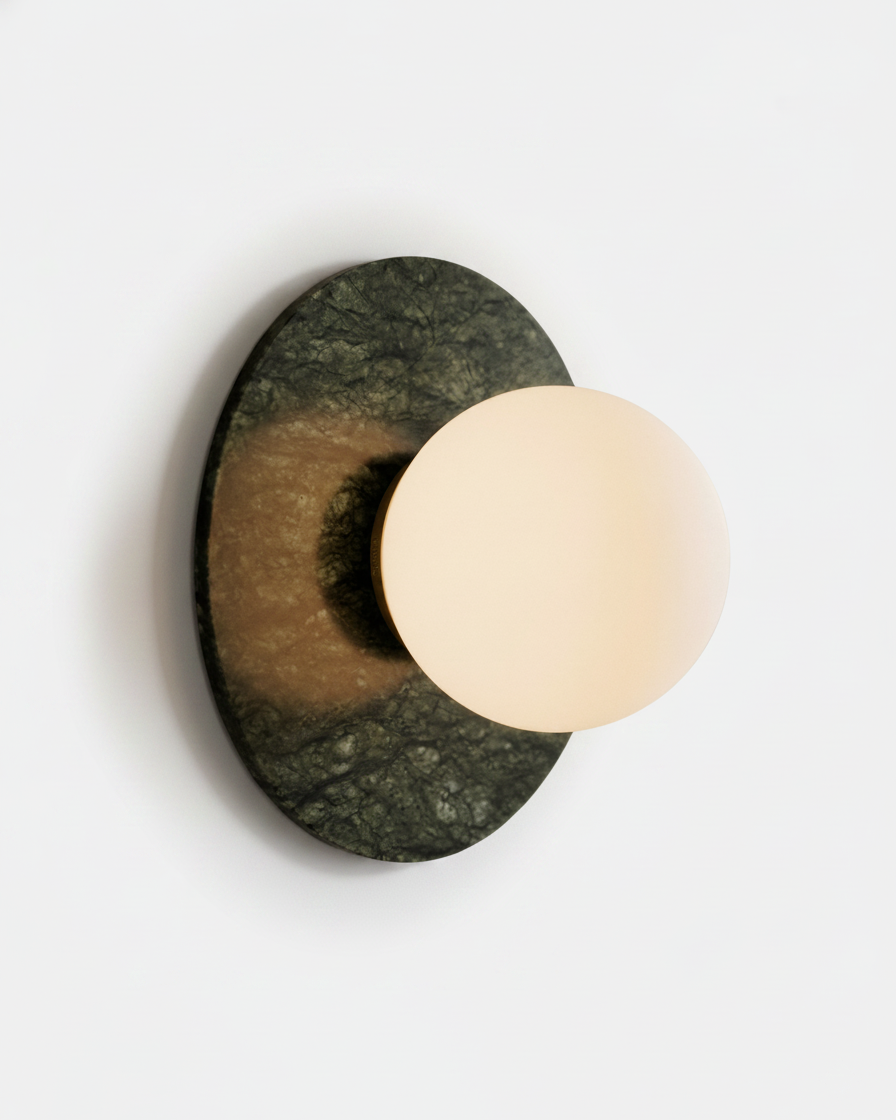
This article gives you the means to test any seller — faubourg & fils included. The Natural Materials collection names the material of each model: travertine, natural stone, walnut, solid wood, brass, rattan. If a piece does not pass the five tests upon receipt, the 14-day right of withdrawal is made for that.











,%20temperature%20to%20the%20touch%20(stone%20stays%20cold,%20resin%20warms%20up%20in%20a%20few%20seconds),%20the%20edge%20(in%20a%20real%20mat...)